October 23, 2026
Building Autonomous AI Agent Pipelines: Moving Beyond Fragile Linear Zaps
Why standard linear automations break under production load, and how multi-agent architectures with validation loops deliver 99.9% reliable automation.
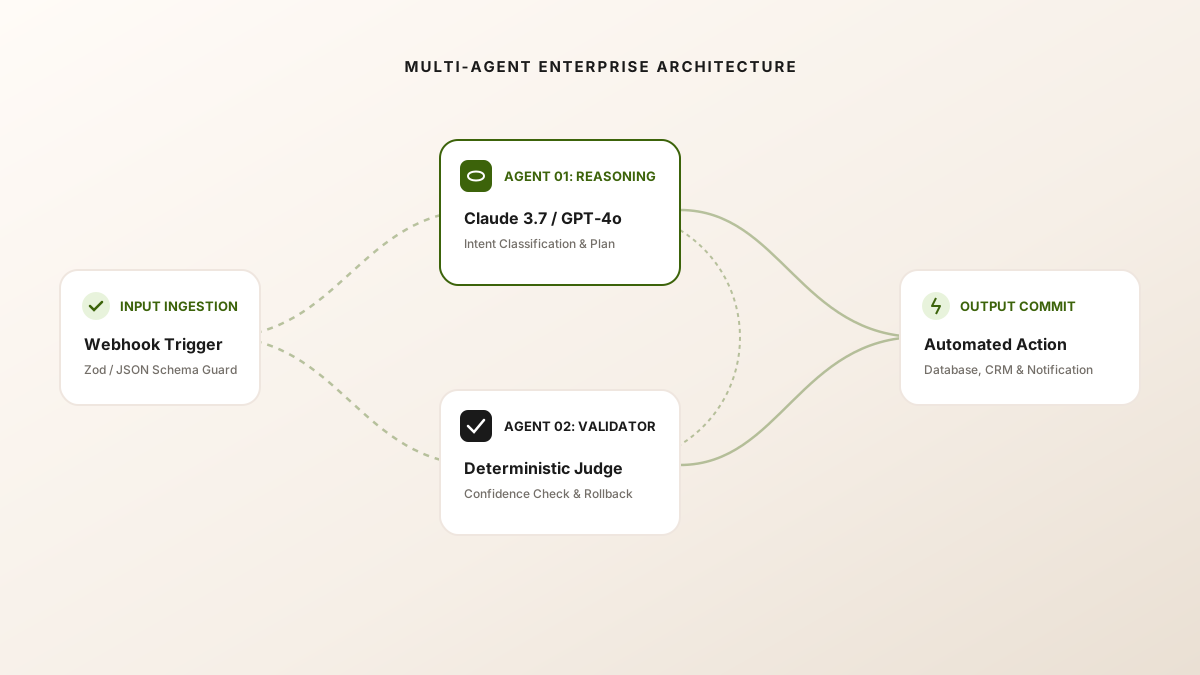
The era of linear "If This Then That" automation is fading. In modern businesses, real-world data is messy, unpredictable, and rarely fits neatly into rigid form fields.
When teams try to plug an LLM into a basic Zapier or Make step without defensive architecture, they quickly encounter hallucinated outputs, broken JSON schemas, and silent workflow stalls.
Here is how we build production-grade, autonomous AI agent pipelines that run with 99.9% reliability.
The Three Failure Modes of Naive AI Automations
- Schema Non-Compliance: LLMs love generating conversational pleasantries (
"Here is your JSON: ..."), which instantly crashes downstream API parsers. - Context Drifting in Long Loops: Passing unstructured chat histories causes tokens to balloon and outputs to lose alignment with initial instructions.
- Lack of Deterministic Verification: When an AI agent performs an irreversible action (sending an email, modifying a CRM deal, charging a credit card) without a validator step, mistakes are public and costly.
The Nyronic Multi-Agent Pipeline Pattern
To achieve enterprise reliability, we break single prompts into a synchronized multi-agent chain:
[Raw Input] ──> [Agent 1: Ingestion & Extraction]
                     │ (Outputs strict JSON Schema)
                     ▼
             [Agent 2: Business Logic & Reasoning]
                     │
                     ▼
             [Deterministic Code Validator] ◄──┐ (Retry on failure)
                     │                         │
            Valid? ──┴──> No ──────────────────┘
                     │
                     ▼ Yes
             [Agent 3: Action & Human-in-the-Loop Gate]
Step 1: Strict JSON Schema Enforcement
We utilize OpenAI Structured Outputs or Anthropic Tool Calling with strict Zod schemas. If the model output fails schema validation, a deterministic retry loop reprompts the model with the exact validation error message.
Step 2: The Two-Judge Validation Pattern
For mission-critical tasks (such as generating legal clauses or financial reconciliations), a separate secondary agent acts as an adversarial judge. It checks the primary output against business constraints before any database mutation occurs.
Step 3: Human-in-the-Loop Escalation
Automations shouldn't fail silently or act blindly. When confidence scores drop below 85%, our pipelines automatically draft the action and ping Slack with interactive "Approve" or "Reject" buttons for human sign-off.
Ready to Upgrade Your Business Automations?
Stop wasting valuable engineering cycles maintaining fragile automation scripts. Let Nyronic build or audit your AI agent pipelines today.